THE FARNHAM SOCIETY |
|
|
WELCOME TO THE FARNHAM SOCIETY WEBSITE
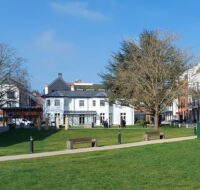
Farnham Town Hall, as reconstructed 1930-1934 is sited at the bottom of Castle Street at the junction with the Borough. A neo-Georgian building designed by local architect Harold Falkner (1875-1963). If you enjoy Farnham, please read on and explore our pages.
PUBLIC CONSULTATION ‘HOW TO INCREASE THE DOG-OWNING POPULATION IN FARNHAM WITHOUT DISTURBING THE BIRDS!' - WAVERLEY BC DRAFT FOR CONSULTATION Waverley's approach to avoiding the impact of new residential development within the 5 km zone which covers most of Farnham Waverley Borough Council has produced an updated plan designed to continue to protect rare birds in heathland while allowing new housing to be built within the 5 kilometre radius of the SPA.. From 8 June until 20 July, Waverley will be seeking views on the proposals drafted to safeguard the Thames Basin Heaths Special Protection Area (SPA) and the rare birds which nest on or close to the ground within it. The proposals are contained in what is called the 'Draft Avoidance Strategy' May 2009. A meeting is to be held at St Andrews Church on Wednesday July 8th from 19:30 - 21:00 to brief representative Farnham organisations and co-ordinate a response. The Church is big and the public is warmly welcomed. If you wish to respond to Waverley's questionnaire, here are our suggestions. Waverley's Questionnaire for the Draft Avoidance Strategy Waverley is asking for views to be submitted by July 20th on its proposals for a method to safeguard the Thames Basin Heaths Special Protection Area (SPA) and the rare birds which nest on or close to the ground within it. The proposals are contained in what is called the 'Draft Avoidance Strategy' May 2009.
As Natural England seems to have no power to enforce a legal ban to prevent walkers with dogs from entering the SPA – the special protection area of about 80 ha on the edge of Farnham, and thus endangering the rare heathland birds, Waverley has proposed a plan designed to encourage new residents to put their dogs in the car and walk them elsewhere, in order to allow their new houses to be built within the surrounding 5 kilometres zone, with its inevitable increase in the total dog-owning population. Without such a plan, the Council is obliged to refuse permission for development of new dwellings within the 5 km zone which covers a large part of Farnham.
In April 2007 Waverley produced an interim plan which was supposed to earmark Farnham Park as a suitable area of natural green space (SANG), to be used for recreational pursuits, such as dog walking, away from the SPA. This avoided the need for developers to provide SANGS themselves. The change, if any, in visitor usage has yet to be monitored and recorded, although the Council has already spent £443,462. The effect on biodiversity in the Park has yet to be monitored.
During the last two years Farnham Park has been ‘enhanced’ to encourage people to use it rather than the SPA, using funds generated from charges paid for new development within the 5 km zone. Improvements to attract visitors to Farnham Park were to include the introduction of a full time park ranger, the construction of a new park office and more information. Waverley's draft plan now includes continued and increased use of Farnham’s historic Park.
In order to permit further development, Waverley wants to consider Farnham Quarry, land to the east of Farnham Park, the Riverside and area south of the A31, the water meadows to the north of the A31 and south of West Street, Bourne Woods and Alice Holt Forest as potential future SANGs (suitable alternative natural green spaces). The Council is keen to get our views on these potential sites.
FARNHAM SOCIETY’S RESPONSE Farnham Society had responded to Waverley's Questionnaire for the Draft Avoidance Strategy as follows: Q - Do you agree that the Draft Avoidance Strategy is the right approach to avoiding adverse impact on the Special Protection Area (SPA)? A - No. It is not the correct approach. The provision of mitigation/avoidance is the responsibility of the developer. WBC has no legal responsibility whatsoever to provide mitigation/avoidance. The consultation paper assumes public assent to the proposition that WBC should assist developers to build specifically within the 5kms zone. This public assent has never been established. Unlike adjacent authorities, only a very small proportion of Waverley falls within the SPA 5km zone of influence. WBC is bound to abide by Regional Policy NRM6. The second paragraph of NRM6 is clear: "Priority should be given to directing development to those areas where potential adverse effects can be avoided without the need for mitigation measures". This advice is mirrored in Government Circular 06/2005 at paragraph 24. The decision taker "must first be satisfied that there are no alternative solutions. If there are alternative solutions that would have no (or a lesser) effect on the site's integrity, then consent cannot be granted in accordance with the Habitat Regulations; permission must be refused or the appeal dismissed." The South East Panel Report (August 2007) paragraph 26.85, allocated WBC 5,000 houses for the plan period, on the assumption that all the 5,000 houses "could be provided outside the 5kms zone of the TBH". In November 2006, at the Examination in Public of the last core strategy, the Inspector made the same point and held that "there does not appear to have been any proper evaluation of development options, which might have reduced the effects which gave rise to the need for mitigation in the first place. In the absence of such a process, the strategy could be held to be unsound against Test VII." Q - What are your views about the suitability of these potential Natural Green Spaces (SANGS)? Continued use of Farnham Park, Farnham Quarry, Land to the east of Farnham Park, Riverside and south of A31, The water meadows (north of the A31) Bourne Woods and Alice Holt, Blackwater Valley A - Since we do not agree that WBC should provide SANGS in order to continue to pursue a policy based on an incorrect assumption, we regard this question as irrelevant. In any case the draft document points out their unsuitability for various reasons. Q - Have you identified any other possible SANGS? A - No, since we do not agree that WBC should provide SANGS in order to allow development to take place which it has not yet been agreed to be required, the question cannot currently be addressed. Q - Do you agree that developers should pay a tariff for the enhancement and maintenance of the SANGS ? A - No, since we do not agree that WBC should provide SANGS on the assumption that development has to be permitted and encouraged, the question cannot currently be addressed. Q - Do you agree that developers should pay an extra tariff for the work that Natural England proposes in relation to access management and monitoring of the SPA itself? A - No, since we do not agree that WBC should be responsible for any action aimed at enabling development to take place until we are satisfied that there has been a proper evaluation of the development options. Q - Do you have any other comments to make on the draft avoidance strategy? A - Yes. This consultation is premature. It is based on an assumption that the distribution and location of the apportionment of housing allotted to WBC in, the South East Plan has already been determined. The consultation paper assumes that Waverley Borough Council has already decided that Farnham will be expected to accommodate at least 540 new houses within 5kms of the Thames Basin Heaths Special Protection Area. However, WBC has yet to complete and consult the public on a Strategic Housing Land Availability Assessment. PPS3 at paragraph 54 requires that WBC "should identify sufficient specific deliverable sites to deliver housing in the first five years". WBC has neither consulted the public on, nor published a schedule containing five years of "specific deliverable sites to deliver housing". Until there is conclusive proof that the housing allocation allotted to WBC by the South East Plan cannot be accommodated by "small adjustments to urban boundaries that would not conflict with MGB, AONB or other environmental designations" or by permitting development at Dunsfold, this consultation is inappropriate and premature.
MESSAGE BOARD Go to the Farnham Society Message Board and read the latest posts. Register, log on and join in or start a discussion, ask for information or express your views.
|